

Embedded & Firmware Engineering
Custom Linux BSPs, RTOS firmware and reliable hardware interfaces.
Embedded Linux, RTOS, firmware, bootloaders, device drivers and hardware bring-up. We take boards from first power-on to a maintainable, updatable platform with a reproducible build system, and we write firmware where deadlines are guaranteed, not hoped for. Our work spans Yocto/Buildroot BSPs, FreeRTOS/Zephyr firmware, kernel drivers and secure boot chains for industrial, automotive and IoT products.
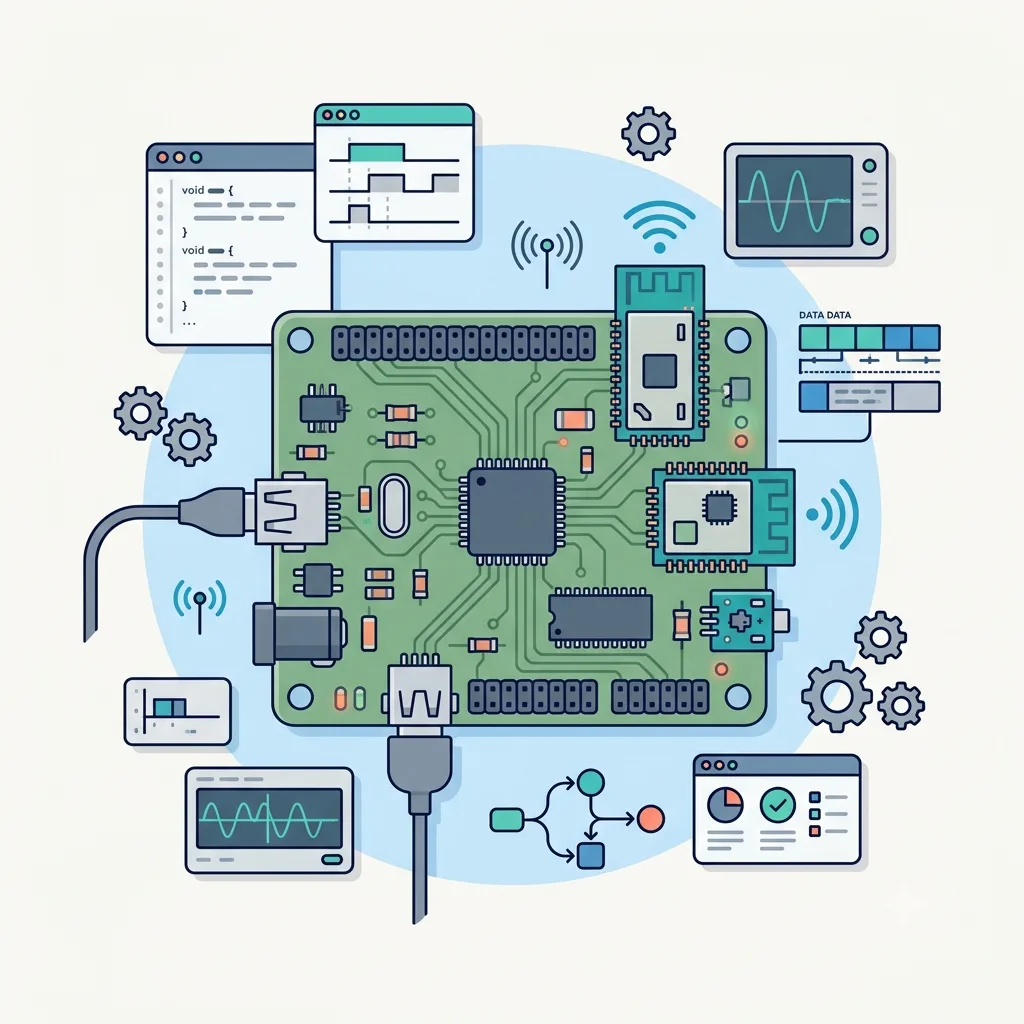
Embedded firmware engineering is the work of writing and maintaining the C/C++ software that runs directly on a board's CPU or MCU: RTOS task scheduling, Linux kernel or RTOS device drivers, inter-process communication, bootloaders and the diagnostics that let you tell a hardware fault from a software one. It covers everything between a schematic and a maintainable, field-updatable platform.
- Custom Yocto/Buildroot BSPs with reproducible, versioned image builds and board bring-up
- RTOS task architecture, scheduling and worst-case timing analysis on FreeRTOS/Zephyr
- Linux kernel and RTOS drivers for SPI, I2C, UART, CAN, LIN, USB and PCIe peripherals
- Secure boot chains, A/B update schemes and OTA rollout with automatic rollback
- Long-term kernel maintenance, CVE patching and platform upgrades
1. Discovery
We map your requirements, constraints, existing systems and success criteria before proposing a solution.
2. Architecture
We design the system architecture, interfaces and technology choices, documented and reviewed with your team.
3. Implementation
We build in short iterations with working increments, code review and continuous integration from day one.
4. Validation
We test against real conditions — hardware, load, failure modes — and report measured results, not assumptions.
5. Deployment
We ship to production with monitoring, documentation and a handover that leaves your team in control.
Where benchmarks are required, Gengini documents throughput, latency, test platform, workload, and measurement method.
Technologies
- Bootable BSP or RTOS firmware with documented build instructions and CI pipeline
- Driver source, device tree bindings and automated test suites
- OTA update mechanism with tested rollback paths
- Bring-up, timing and validation reports on real hardware
- Platform maintenance and upgrade plan
Which SoC families do you work with?
We work with common industrial and automotive SoCs including NXP i.MX, TI Sitara/Jacinto, Renesas R-Car, Raspberry Pi CM and STM32MP families. If a vendor BSP exists, we can adapt it; if not, we do mainline-based bring-up.
Can you add OTA updates to an existing product?
Yes. We retrofit A/B or dual-copy update schemes using tools like SWUpdate, Mender or RAUC, including bootloader fallback logic so a failed update never bricks the device.
Can you work within an existing firmware codebase?
Yes. Most engagements start from existing firmware. We profile it first, identify scheduling, memory or driver issues, and make incremental changes with regression tests rather than rewriting.
Do you write both Linux drivers and RTOS drivers?
Yes — the two are different disciplines. Linux drivers work within the kernel's device model and locking rules; RTOS/bare-metal drivers manage hardware directly against a deadline. We write both depending on which side of the board your peripheral sits on.
How do you diagnose a hardware fault versus a firmware bug?
We start with a serial console, JTAG/SWD and, where available, a scope or logic analyzer on the failing bus. Reproducing the fault under instrumentation before changing code prevents 'fixes' that just mask a timing or signal-integrity issue.
Do you handle inter-process and inter-core communication?
Yes. Shared-memory IPC, message queues and mailbox-based communication between Linux and an RTOS core (or between processes on the same core) are a normal part of bring-up on asymmetric multi-core SoCs.
How to Design a Simple SOME/IP Service Discovery Demo
A step-by-step implementation guide for building a minimal SOME/IP service discovery demo using vsomeip on Linux and QEMU.
Troubleshooting SOME/IP Service Discovery in Linux and Docker
A diagnostic playbook for fixing SOME/IP service discovery failures caused by multicast routing, Docker networking, and firewall misconfiguration.