

AI Automation
AI workflow automation, voice agents, CRM automation, content automation and operational AI systems.
We design and deploy n8n-based automation that connects CRMs, inboxes, telephony and internal tools into AI-assisted workflows. From lead qualification to support ticket triage to content operations, we replace manual, repetitive work with dependable, observable pipelines. Every workflow ships with error handling, human approval gates where they matter, and documentation your team can maintain.
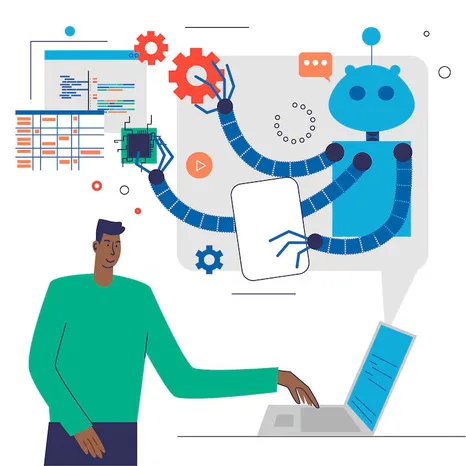
AI automation connects your CRM, inbox, forms and internal tools through orchestrated workflows — typically built in n8n — so lead capture, qualification, support triage and content operations run without manual handling. An LLM does the classification, drafting, scoring or retrieval-augmented lookups at the steps that need judgment; a human approves anything customer-facing that carries risk.
- Lead capture, enrichment and CRM sync across HubSpot, Pipedrive and Salesforce
- AI-assisted lead scoring, segmentation and personalized outreach sequences
- Support and ticket triage with AI classification and priority detection
- Content operations: briefs to drafts, SEO metadata and publishing pipelines
- Human approval gates before anything customer-facing goes out automatically
1. Discovery
We map your requirements, constraints, existing systems and success criteria before proposing a solution.
2. Architecture
We design the system architecture, interfaces and technology choices, documented and reviewed with your team.
3. Implementation
We build in short iterations with working increments, code review and continuous integration from day one.
4. Validation
We test against real conditions — hardware, load, failure modes — and report measured results, not assumptions.
5. Deployment
We ship to production with monitoring, documentation and a handover that leaves your team in control.
Where benchmarks are required, Gengini documents throughput, latency, test platform, workload, and measurement method.
Technologies
- Deployed n8n workflows connected to your existing tools
- Scoring, triage and routing rules documented and tunable
- Notification and escalation configuration for the events that matter
- Admin guide for safely modifying workflows after handover
Will automation create duplicate CRM records?
No — deduplication is a core part of every build. Workflows match on email, domain and fuzzy company names before creating records, and merge or update instead of duplicating.
Can workflows run on our own server?
Yes. n8n self-hosts cleanly, which keeps your data inside your infrastructure. We deploy it with backups and monitoring, or use n8n Cloud if you prefer managed hosting.
Does the AI reply to customers directly?
Only where you allow it. The default design drafts replies and suggestions for a human to approve; fully automatic actions are reserved for narrow, low-risk cases you choose.
What is RAG and do we need it?
Retrieval-augmented generation lets a workflow look up your own documents, tickets or product data before an LLM drafts a reply, instead of relying only on the model's training data. It's worth adding once answers need to reference your specific policies, pricing or knowledge base rather than general knowledge.
Can automation trigger from a webhook or a spreadsheet?
Yes. Most workflows are triggered by an inbound webhook, a form submission or a scheduled poll of a source like Google Sheets, and we pick whichever trigger matches how the data actually arrives in your business.
How do you handle errors in a live workflow?
Every workflow has explicit error branches — retries with backoff for transient failures, and a notification to a human for anything that fails repeatedly — so a broken integration surfaces as an alert, not a silent data gap.
AI Voice Agent Architecture: Phone Service, ADB, Bluetooth HFP, and Workflow Engine
A reference architecture for AI voice agents built on physical telephony hardware, covering the phone service layer, ADB control plane, HFP audio bridge, and workflow engine.
Reducing Voice Agent Turn Latency: Practical Optimization Techniques
Concrete, prioritized optimization techniques for reducing voice agent turn latency across STT, LLM, and TTS stages, based on measured impact.
Building a SIM-Based AI Voice Agent Without Per-Minute Telephony Billing
How to build an AI voice agent that answers real phone calls using an Android phone, ADB, and Bluetooth HFP instead of per-minute telephony APIs.